
Stellar has long been seen as a project that lost much of its market spotlight. While Ethereum, Solana, Layer 2 networks and newer DeFi ecosystems attracted most of the attention, XLM was often treated as an asset from an earlier crypto cycle. However, recent developments suggest that Stellar has not disappeared from the market. Instead, the network is gradually trying to build a new role as infrastructure for tokenized real-world assets.
The key question is no longer whether Stellar can process fast and low-cost payments. That has been one of its core strengths for years. The more important question is whether the network can become a relevant platform for RWA, institutional settlement and programmable payments — and whether this could eventually affect the price of XLM.
Why Stellar Is Back in Focus
Stellar was launched in 2014, making it one of the older blockchain projects in the crypto sector. Its original focus was international payments, fast transfers and accessible financial infrastructure.
This is why Stellar is often compared with Ripple. The two projects overlap in several areas: both focus on payments, both aim to work with financial institutions, and both are often viewed as alternative infrastructure for cross-border transactions.
Over the years, Stellar has built a broad network of partnerships. Companies associated with its ecosystem include Visa, Mastercard and Circle. In several countries, initiatives involving public-sector institutions have also been launched.
But past partnerships alone are no longer enough. The crypto market has changed significantly. Investors now look not only at transaction speed, but also at real usage, liquidity, DeFi activity, institutional demand and the ability of a network to gain relevance in new market segments.
RWA Could Become Stellar’s Main Growth Driver
Real World Assets, or RWA, are one of the most discussed trends in the crypto industry. The idea is simple: traditional financial instruments are represented on blockchain as tokens.
These assets may include:
- government bonds;
- money market products;
- debt instruments;
- assets backed by real financial products;
- other forms of tokenized value.
For Stellar, this sector is becoming increasingly important. According to Messari, the market capitalization of tokenized assets on Stellar, excluding stablecoins, rose by 91% in the first quarter and reached $1.52 billion. In April, the figure surpassed $2 billion.
This growth suggests that Stellar is increasingly being used not only as a payment network, but also as infrastructure for bringing traditional financial products into blockchain-based markets.
Tokenized Treasury products and money-market-related instruments play a particularly important role in this trend. Projects such as Ondo and Spiko have been among the key contributors to growth in this segment.
Why This Matters for the Stellar Ecosystem
The rise of RWA changes how Stellar can be perceived. Previously, the project was mostly associated with cheap and fast transfers. Now it may also be viewed as a platform for more advanced financial use cases.
This shift matters for several reasons.
First, the RWA market is not aimed only at retail crypto users. It also attracts institutional participants. For these players, reliability, transparency, compliance and clear infrastructure are essential.
Second, tokenized real-world assets can create more sustainable network activity than short-term speculation. When financial products are placed on-chain, users interact with them not only for hype, but for access to yield, liquidity and settlement mechanisms.
Third, RWA can act as a bridge between traditional finance and crypto. Stellar has long tried to position itself in this middle ground, and that narrative is now becoming relevant again.
DeFi on Stellar Is Growing, but There Is No Breakthrough Yet
Apart from RWA, there are also changes in Stellar’s DeFi segment. However, the picture is mixed.
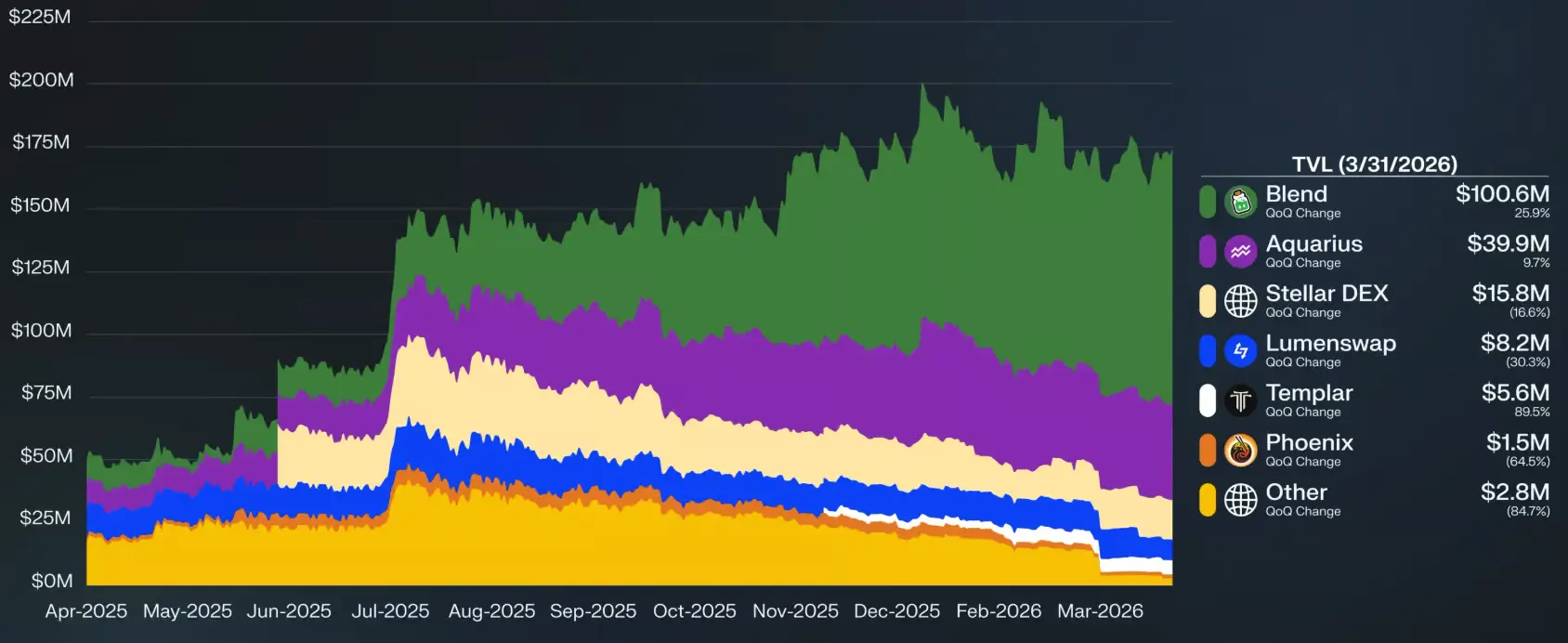
On one hand, decentralized exchanges in the ecosystem are losing part of their market share. This suggests that trading activity is not currently the main growth engine for Stellar.
On the other hand, lending and borrowing protocols such as Blend and Templar are showing stronger momentum. User interest in these protocols is largely connected to yields on stablecoin deposits.
For DeFi, this is logical. When users can deposit stablecoins and earn attractive yields, they have a practical reason to use the network.
Still, the overall scale of DeFi on Stellar remains limited. Total Value Locked at the end of the quarter stood at $174.4 million, almost unchanged from the previous period. This means that some segments are growing, but the ecosystem as a whole is not yet showing explosive expansion.
What Prevents Stellar From Becoming a Major DeFi Player
Stellar’s main challenge is competition.
Over the past few years, the blockchain market has changed dramatically. Users and developers now have many alternatives, including Ethereum, Solana, Arbitrum, Base, Avalanche, Sui, Aptos and other networks competing for liquidity, projects and investor attention.
Against this backdrop, Stellar has to prove that it is not just an older, reliable blockchain, but a modern financial infrastructure with clear advantages.
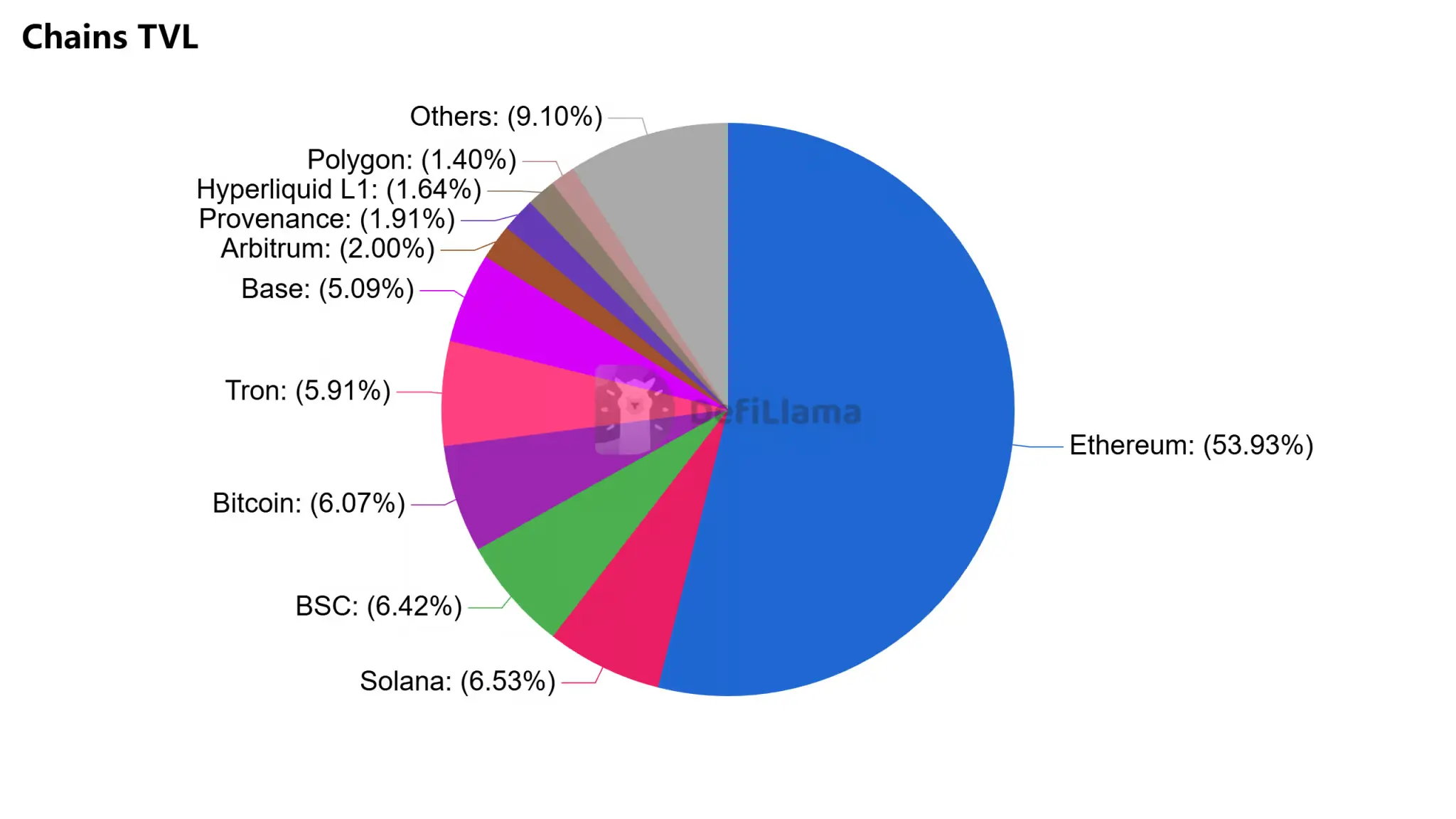
So far, Stellar does not rank among the leading networks by TVL and is not a dominant platform for stablecoin liquidity. According to DeFiLlama, the network is roughly around the top 20 by stablecoin market capitalization. For a project that has long positioned itself as payment infrastructure, that is a modest result.
This is why RWA growth is important, but it does not yet guarantee a market breakout.
Technical Upgrades: Stellar Is Preparing for a New Type of Payments
Another area of Stellar’s development is protocol-level innovation.
In recent months, the network has introduced new tools, including the x402 protocol and the Machine Payments Protocol. Their goal is to create a foundation for automated payments between applications, services and APIs.
This is important because digital payments are gradually moving beyond the simple model of one user sending money to another. In the future, payments may increasingly happen between software systems, bots, services, platforms and automated agents.
Such solutions could be used for:
- API request payments;
- micropayments between digital services;
- automated settlement between applications;
- machine-to-machine transactions;
- financial operations without direct manual user involvement.
If Stellar succeeds in this area, the network could gain an additional source of activity.
Zero-Knowledge Features and Institutional Use Cases
Another important development is the X-Ray upgrade, which is related to Zero-Knowledge functionality.
For the institutional market, this could be an important step. Financial organizations often need two things at the same time: transaction privacy and regulatory compliance. Zero-Knowledge technologies can potentially help combine these requirements.
This is especially relevant for Stellar because the project has long focused on real financial use cases, payments and interaction with regulated market participants.
If these features gain practical adoption, Stellar could strengthen its position among projects operating at the intersection of crypto and traditional finance.
Why the XLM Price Has Not Reacted Strongly Yet
Despite RWA growth and infrastructure development, the XLM price has not shown a strong upward trend. In the first quarter, the token lost around 16% of its value.
At first glance, this may seem contradictory: the network is developing, some metrics are improving, but the market is not rushing to reprice the asset.
However, this is common in crypto. Growth in blockchain activity does not always translate immediately into token price appreciation. Investors evaluate not only news and technical upgrades, but also how the token is connected to the network’s economic activity.
In Stellar’s case, the market may still have doubts about several issues:
- whether RWA growth can become sustainable;
- whether XLM directly benefits from increased activity;
- whether Stellar can compete with more popular networks;
- whether liquidity and users will continue to grow;
- whether major investors will regain interest in older crypto projects.
As long as these questions remain open, XLM may continue to move weaker than Stellar supporters expect.
Stellar vs. Newer Blockchains: The Main Challenge
Stellar has clear strengths: a long history, strong brand recognition and a focus on payments. But older projects also face a challenge: it is harder for the market to believe in a new growth story.
Younger blockchains often attract more attention because they are easier to frame around new technology, new ecosystems, new capital and new users. Stellar has to prove that it can do more than survive. It has to show that it can become relevant again.
Its potential advantage is not hype, but practical financial infrastructure. If the RWA market continues to grow and institutions look for proven networks for tokenized assets, Stellar could gain a second life.
But this is not a short-term scenario. It requires months or years of consistent development.
What Could Support XLM in the Future
For XLM to receive a stronger market revaluation, investors need more than isolated growth metrics. They need clear signs that the ecosystem is expanding in a sustainable way.
Key factors may include:
- continued growth of RWA capitalization on Stellar;
- higher TVL in DeFi protocols;
- stronger stablecoin liquidity;
- new institutional products;
- real usage of machine payments;
- growth in daily transactions;
- a stronger role for XLM inside the ecosystem;
- renewed market interest in payment-focused blockchains.
If several of these factors align, XLM could receive a stronger market impulse.
The Main Risk for Stellar
The main risk is that ecosystem development may not translate into sustainable demand for XLM itself.
This is a common issue in crypto. A network may be useful, its technology may improve, and partnerships may look promising, but the token price does not always follow infrastructure growth.
For investors, this is crucial. It is not enough to look at whether activity inside the network is increasing. It is also necessary to understand what role XLM plays in that activity.
If the token does not become an essential part of the network economy, its price may remain under pressure even while the project continues to develop.
Stellar Outlook: Cautious Optimism Without Euphoria
Stellar currently does not look like a project that has suddenly returned to the center of the crypto market. Rather, it looks like a network trying to find a new strong niche.
RWA could indeed become that niche. The growth of tokenized assets on Stellar shows that the network has real use cases. Technical upgrades also expand the project’s capabilities, especially in programmable and automated payments.
Still, this is not enough to claim that Stellar has fully returned to the top tier of crypto projects. The network needs to prove that growth is not limited to individual metrics, but is turning into sustainable ecosystem momentum.
FAQ
What is Stellar?
Stellar is a blockchain network launched in 2014. It focuses on fast, low-cost and accessible payments, as well as financial infrastructure for digital assets.
Why is Stellar often compared with Ripple?
Both projects are connected to payments and cross-border settlement. That is why they are often discussed in the same context, although they are technically and organizationally different ecosystems.
What is RWA on Stellar?
RWA refers to tokenized real-world assets, such as bonds or money market products. On Stellar, this segment is growing quickly and is becoming one of the network’s key areas of development.
Why is RWA growth important for XLM?
RWA growth can increase Stellar’s relevance as financial infrastructure. However, it does not automatically guarantee XLM price growth, because the token’s value depends on demand, liquidity and its role inside the ecosystem.
Why is XLM not rising despite Stellar’s development?
The market remains cautious about Stellar’s prospects. Investors want to see not only technical upgrades and growth in some metrics, but also sustainable user growth, liquidity expansion and real demand for XLM.
Can Stellar become a major crypto project again?
In theory, yes, especially if the RWA market continues to expand. However, Stellar needs to strengthen its position in DeFi, stablecoins, institutional products and real network usage.
Expert Takeaway
Stellar is gradually changing its role in the crypto market. From an older payment-focused blockchain, it is trying to become infrastructure for tokenized assets, programmable payments and institutional financial solutions.
This makes Stellar more interesting than it looked in recent years. The growth of RWA is especially important because it could give the network a new long-term development path.
However, the outlook for XLM remains mixed. So far, stronger ecosystem activity has not led to a major market revaluation of the token. For that reason, Stellar can be viewed as a project with recovery potential, but not yet as an obvious leader of the next crypto cycle.
For investors, the key indicators are not only announcements and upgrades, but real metrics: RWA growth, TVL, stablecoin liquidity, user activity and demand for XLM. If these indicators begin to improve at the same time, Stellar will have a stronger chance of returning to the attention of major market participants.